Digital Impressions
Digital Impressions
A dental impression is a record of the shape of your teeth and gums. At Brilliant Dental Group, a quick digital scan takes the place of messy impression trays and gives an accurate picture of your teeth. This page explains how digital impressions work, how they fit into care here, and what a visit involves.
What digital impressions are
For many years, an impression meant biting into a tray of soft material that hardened around the teeth. The tray was removed, and the mold was used to make models and restorations. It worked, but many people found it uncomfortable. The tray can be bulky, the material can taste unpleasant, and some people feel a gag reflex.
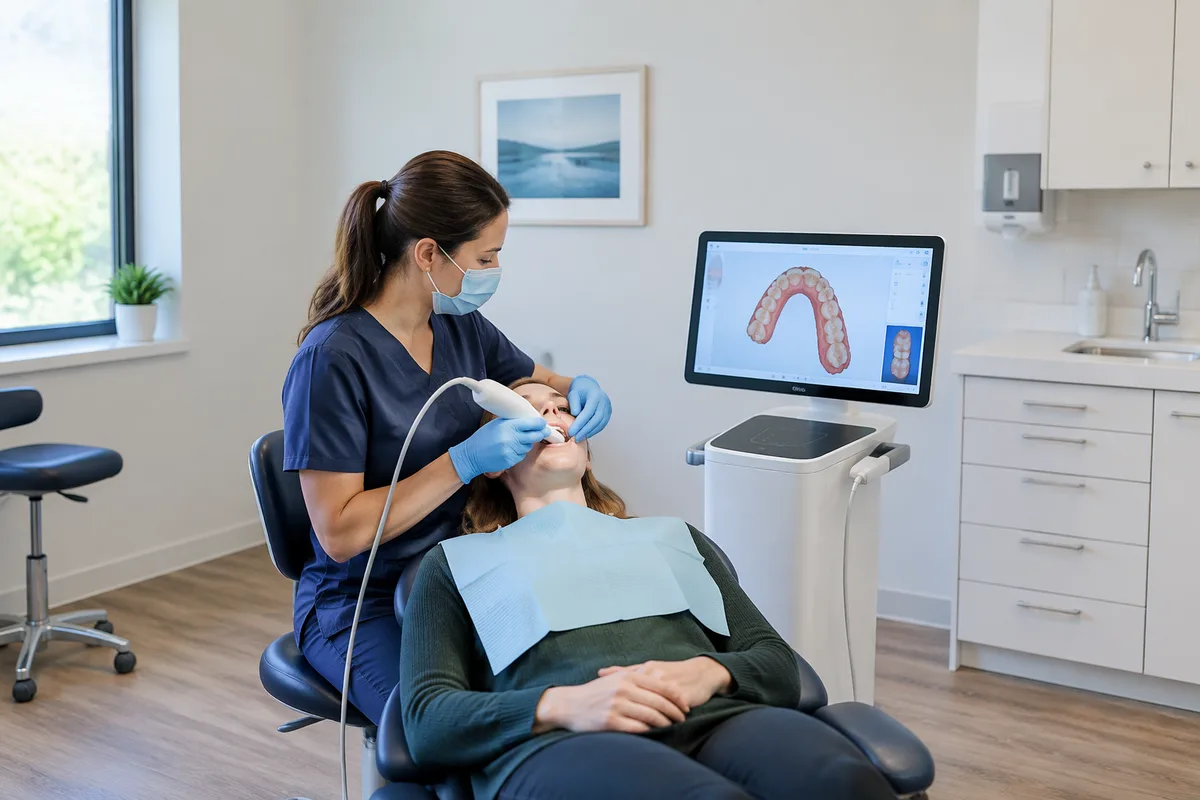
A digital impression records the same information with a small handheld scanner, called an intraoral scanner. The scanner is moved gently over the teeth and gums. It captures many images and software stitches them into a detailed 3D model on a screen. No tray or setting material is needed.
A digital impression is not the same as an X-ray. A scan captures the surfaces of your teeth and gums, meaning their shape, position and how they fit together. X-rays show what is happening beneath the surface.
How we use it at Brilliant Dental Group
Our digital impressions are a quick scan that replaces traditional trays. They work alongside other technology in our office, especially 3D dental printing. In-office 3D printing makes precise dental models, guides and appliances from your digital scan, so the scan becomes the starting point for physical items.
Scans also connect to other tools we offer:
- Digital Smile Design — lets you preview planned cosmetic changes before treatment begins, and a digital record of your teeth is a natural foundation for that kind of planning.
- Computerized Bite Analysis — measures how your teeth meet, helping us find and balance uneven pressure.
- Digital X-Rays — show what is happening inside your teeth and gums, complementing what a surface scan shows.
In general dentistry, digital impressions are commonly used for restorations such as crowns, bridges, inlays and onlays, and for clear aligners, night guards and mouthguards. Dr. Sami Hersel has training in restorative, cosmetic and implant dentistry and in orthodontics, all areas where an accurate record of the teeth matters. Ask our team whether a digital impression is part of your treatment.
What it means for you
The most noticeable benefit is comfort. With no tray to hold in your mouth and no material to wait on, many people find a scan easier, especially if they dislike the gagging sensation or the taste of traditional impression material.
Other general benefits of digital impressions include:
- Accuracy — a detailed digital model shows the shape of your teeth and how they meet, with no mold that can distort.
- Clear communication — you can see your own teeth on screen while the dentist points out areas of concern or explains a plan.
- Easy to retake — if one area of the scan is unclear, that section can be rescanned without starting over.
- A digital record — your scan can be saved and compared with later scans to notice changes over time.
What to expect during your visit
Before. There is usually little to prepare. Brush as you normally would, and tell us about any concerns, such as a strong gag reflex or sensitive teeth, so we can take them into account.
During. You will sit back in the chair while the scanner is moved slowly over your teeth and gums, one area at a time. You may be asked to open wide or to bite together at certain points so the software can capture how your teeth meet. Most people feel only the scanner wand touching their teeth, with no pressure from a tray. Scan time depends on how much of your mouth needs to be captured.
After. Nothing needs to wear off, and there is no impression material to rinse out. The model appears on screen, where we can review it with you and explain the next steps for your care.
Frequently asked questions
Is a digital impression safe?
Intraoral scanners generally use light to capture images, not X-rays, and nothing is injected or placed permanently in your mouth. The scanner wand is simply held near your teeth. If you have questions about your own health history, ask our team before your visit.
Is it uncomfortable?
Many people find scanning more comfortable than traditional trays because there is no bulky tray and no material to set. You may still need to hold your mouth open for a while, and individual experiences vary. Let us know if you need a break.
How long does it take?
The scanning itself is generally quick, though the time depends on whether we are capturing a single area or your whole mouth. It is usually one part of a longer appointment rather than a visit of its own. Our team can tell you what to expect for your situation.
Who can have a digital impression?
Digital impressions are suitable for many patients, including those who need restorations, aligners or protective appliances. If you have a strong gag reflex, a scan may be an easier option than a tray. Whether it is the right choice for your treatment is something your dentist will decide with you.
If you would like to know more about digital impressions or how they could fit into your care, book a visit or get in touch with Brilliant Dental Group. We are happy to answer your questions.
This content is for general information only and isn't dental or medical advice. Talk with your dentist or orthodontist about your own situation. If you have a medical emergency, call 911.