
Digital X-Rays
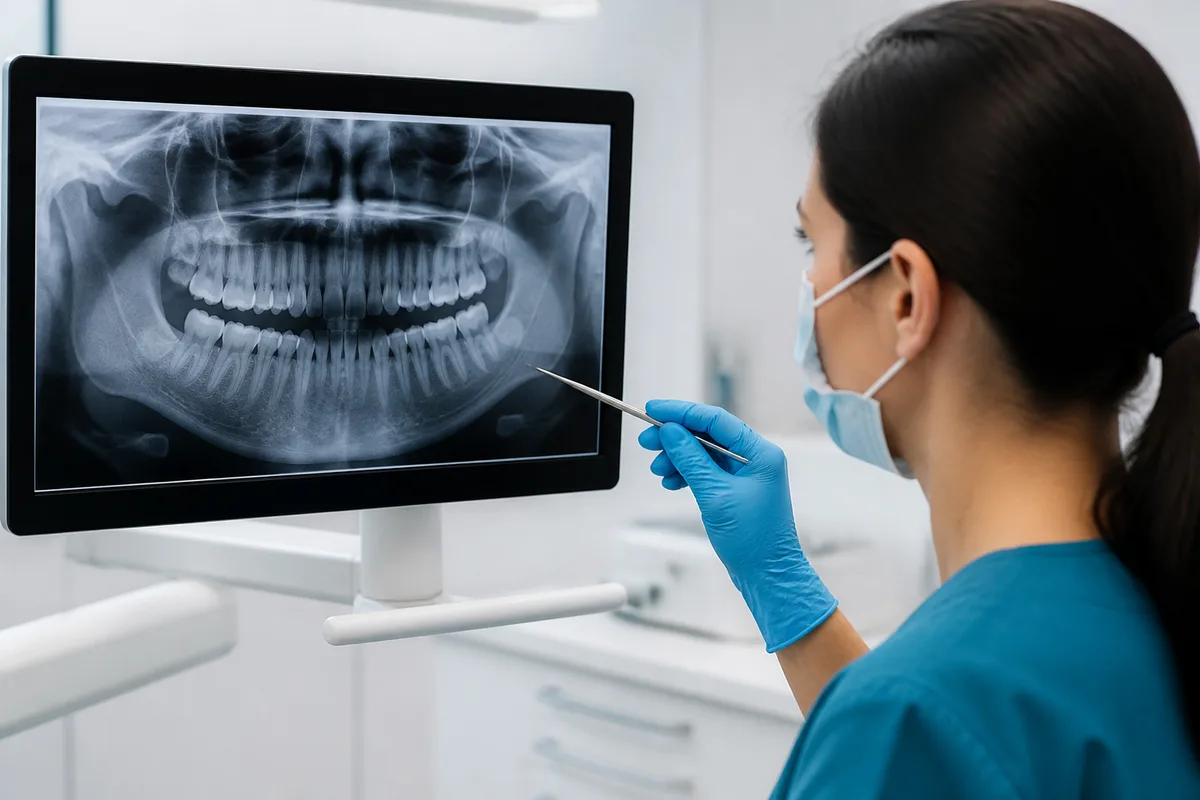
Digital X-Rays
Digital X-rays let a dentist see what is happening beneath the surface of your teeth and gums, without any cutting or guesswork. At Brilliant Dental Group, they are part of our comprehensive dental examination. This page explains what they are, how they work, and what to expect.
What digital X-Rays is
A dental X-ray is a picture of the parts of your mouth that cannot be seen by looking inside it: the roots of your teeth, the bone that supports them, the spaces between teeth, and the areas under existing fillings or crowns. Digital X-rays take this kind of picture with an electronic sensor instead of the chemically processed film used in the past.
The sensor captures the image and sends it to a computer, where the dentist can view it on a screen. Because the image is digital, it can be enlarged, adjusted for brightness and contrast, and saved in a patient's record for comparison at later visits. Digital systems are also generally known to use less radiation than traditional film.
The purpose stays the same as ever: finding problems that are invisible to the naked eye, ideally while they are still small.
How we use it at Brilliant Dental Group
Digital X-rays are included in our comprehensive dental examination. They let us see what is going on inside your teeth and gums without surgically cutting them open to observe. In practice, that means the exam is not limited to what can be seen on the surface.
Dr. Sami Hersel, our dentist, emphasizes teaching and educating patients to prevent dental disease and oral health issues. Images are a natural part of that, because it is easier to understand a concern when you can see it. Dentists commonly rely on X-rays in several areas of care:
- Checkups and exams — looking for decay between teeth, below the gumline, or under older restorations.
- Gum and bone health — assessing the bone around teeth, which matters when evaluating periodontal concerns.
- Treatment planning — understanding the roots and surrounding bone before procedures such as fillings, crowns, root canal therapy, extractions, or implants.
What it means for you
The biggest benefit is early information. Many dental problems cause no symptoms at first, and an X-ray can reveal them before they become painful or harder to treat. Finding a small cavity sooner generally allows for simpler care than finding it later.
Digital images also make conversations clearer. Rather than simply being told what a dentist sees, you can look at the picture together and understand why a particular treatment is or is not being recommended. Many people find that helpful when making decisions.
Other general advantages of digital imaging include:
- Lower radiation — digital sensors generally need less exposure than film.
- No film processing — images are available on screen rather than after developing.
- Easy comparison — stored images can be reviewed against future ones to track changes over time.
What to expect during your visit
No special preparation is needed. Let our team know if you are or might be pregnant, or if you have any health concerns, so the dentist can take that into account.
During your exam, you will be seated comfortably and a protective covering may be placed over you. A small sensor is positioned in your mouth, usually held in place by gently biting down. The machine is then briefly activated while you stay still, and the process is repeated for the other areas that need to be seen. The exposure itself lasts only a moment, though positioning the sensor can feel slightly awkward for some people.
Afterward, the images appear on a computer screen for review. The dentist can go over what they show and what, if anything, needs attention. There is no recovery time, and you can carry on with your day as usual.
Frequently asked questions
Are digital X-rays safe?
Dental X-rays involve a very small amount of radiation, and digital sensors generally require less than traditional film. Protective coverings and careful technique further limit unnecessary exposure. If you have concerns, especially about pregnancy, talk with our team before your exam.
Do digital X-rays hurt?
The X-ray itself is not painful. Some patients find the sensor a little bulky or uncomfortable to hold between their teeth for a few seconds. If you have a sensitive gag reflex or tender teeth, tell us so we can help you feel more at ease.
How often will I need X-rays?
It varies from person to person, depending on your dental history, current oral health, and any symptoms or treatment underway. Your dentist decides what is appropriate for you. Ask our team what makes sense in your situation.
Who can have digital X-rays?
Dental X-rays are used for patients of many ages, from children to older adults, whenever the dentist needs to see beneath the surface. If you are pregnant or have a medical condition that raises questions, mention it ahead of time so your dentist can decide the best approach.
If you would like to know more about digital X-rays or schedule a comprehensive exam, please get in touch with Brilliant Dental Group. We are happy to answer your questions.
This content is for general information only and isn't dental or medical advice. Talk with your dentist or orthodontist about your own situation. If you have a medical emergency, call 911.